

Nanomolecular medical imaging
Red Carbon Dots
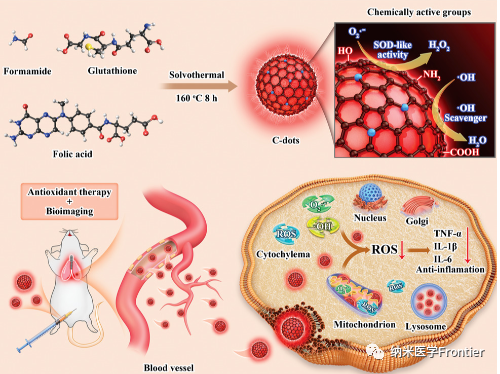
The subject of this study is red carbon dots (CDs), a nanomaterial with superoxide dismutase-mimicking enzyme activity (SOD), which can be used for bioimaging and improving acute lung injury (ALI).
The innovation of this study is to use the high photoluminescence and high SOD activity of carbon dots to realize the visual detection and effective removal of oxidative stress in the lungs. The red emission peak of carbon dots is located at 683 nm, which has high tissue penetration and low background signal. The SOD activity of carbon dots is as high as 4000 U/mg, much higher than the natural SOD enzyme.
The experimental results show that the carbon dots can enter the lungs through intravenous injection and generate a strong red light signal in the lungs, showing good biological imaging capabilities. Carbon dots can also effectively remove excess reactive oxygen species (ROS) in the lungs, reduce the level of pro-inflammatory factors, and protect living cells from damage, thereby improving the pathological conditions of ALI.
This study provides a new type of red light carbon dot nanomaterial, which provides a new strategy for bioimaging and antioxidant therapy, and has the advantages of simple preparation, low cost, and good biocompatibility.
Mannose-modified p-CDs (mp-CDs)
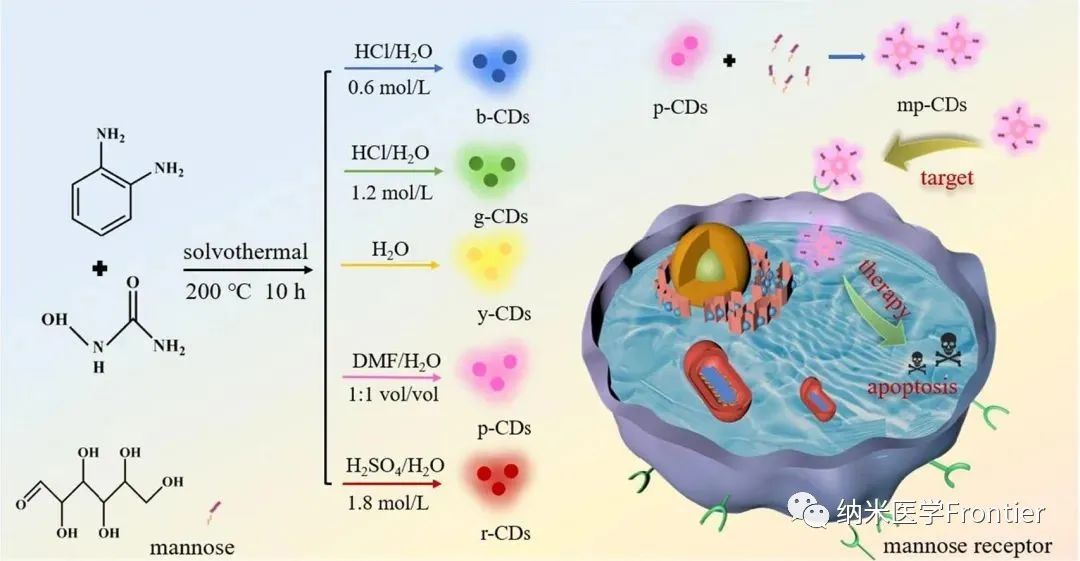
Pink carbon dots (p-CDs) are a kind of carbon nanomaterials with fluorescent properties, which can be used in biological imaging, sensing, catalysis and other fields. The quantum yield of p-CDs refers to the proportion of fluorescent photons they emit, and generally the higher the better. The p-CDs have a quantum yield of 46%, which means they have high fluorescence intensity and stability.
In order to improve the application value of p-CDs in biomedicine, researchers modified the surface of p-CDs with mannose to obtain mannose-modified p-CDs (mp-CDs). mp-CDs can selectively target tumor cells because of overexpressed mannose receptors on the surface of tumor cells. The mp-CDs enter the interior of tumor cells through endocytosis, and emit bright pink fluorescence under ultraviolet light, so that liver cancer cells can be identified with the naked eye.
mp-CDs can be used not only for the imaging of HCC cells, but also for the treatment of HCC cells. The hydroxyurea functional groups on the surface of mp-CDs can form coordination bonds with mannose, thereby enhancing the binding force between mp-CDs and tumor cells. When mp-CDs are exposed to near-infrared light, they generate high temperature and reactive oxygen species, which induce tumor cell apoptosis. This method of using mp-CDs to achieve targeted imaging and therapy of liver cancer cells is called "fluorescence diagnosis/photodynamic therapy"
Full-color CDs
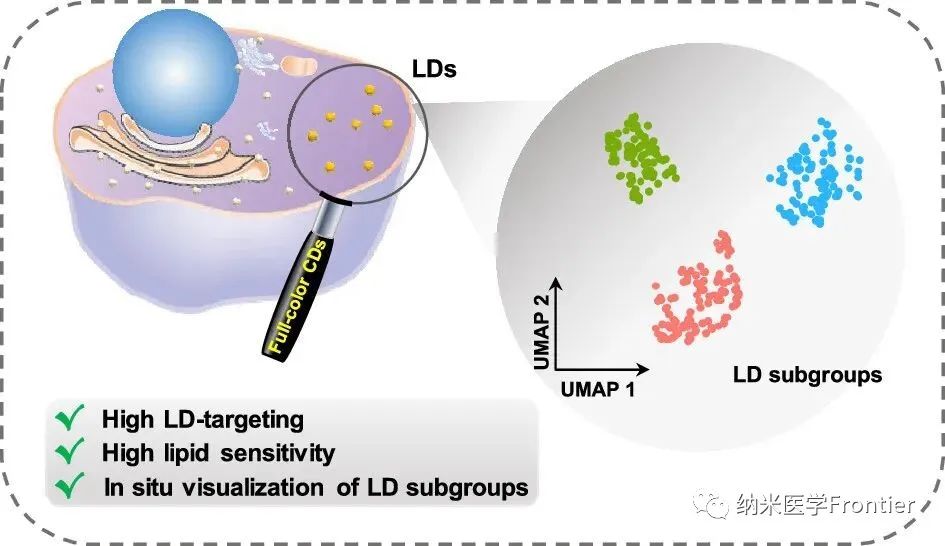
Full-color CDs are carbon quantum dots with full-color fluorescence emission, and they are composed of a variety of functionalized carbon nanomaterials. The lipophilicity and surface luminescence of full-color CDs allow them to target lipid droplets (LDs), intracellular organelles that store neutral lipids. Lipid droplets play an important role in maintaining the energy metabolism balance of cells and organisms, and the changes of lipid composition inside them are related to many metabolic diseases. Full-color CDs can visualize and quantify the internal structure and function of lipid droplets by responding highly sensitively to subtle differences in the internal lipid composition by fluorescent signals. This method of lipid droplet imaging and detection using Full-color CDs provides new tools and strategies for studying biological issues related to lipid droplet metabolism.
18915694570